How Treasury Bill Discount Income Works
T-bills pay no interest — you buy below face value and receive the full face value at maturity. How to calculate the discount, the return over the holding period, and an annualised rate, with a worked example.
Treasury bills are among the simplest investments a government issues, but they don't work like a savings account or a bond. They pay no interest along the way. Your entire return comes from one thing: the gap between what you pay and what you get back.
The basic idea
A T-bill has a face value — the amount the government will pay you on the maturity date. You buy it for less than that, at a discount. When it matures, you receive the full face value.
Discount income = face value − purchase price
Common maturities include 91, 182 and 364 days (for example in Kenya), or 4 to 52 weeks (in the United States). The shorter the bill, the smaller the discount.
A worked example
You buy a 182-day bill with a face value of 100,000 for 97,000.
- Discount income: 100,000 − 97,000 = 3,000
- Return over the holding period: 3,000 ÷ 97,000 = 3.09%
- Simple annualised return: 3.09% × 365 ÷ 182 ≈ 6.20%
The annualised figure lets you compare bills of different lengths, and compare a bill with other investments quoted per year.
To run the numbers for your own bill, with tax, use the T-bill calculator (or the Kenya version, set up for CBK's pricing).
Why the quoted rate may not match your number
Auction results and bank quotes often use a specific convention — a discount rate calculated on the face value rather than on what you paid, or a 360-day year — so the published rate can differ slightly from the simple annualised return above. Neither is wrong; they answer slightly different questions. What matters for your own records is the cash: what you paid, and what you received. The T-bill calculator shows the same bill both ways.
Taxes
In many countries T-bill discount income is taxed like interest, and in some it's withheld at source. Record the amounts you actually paid and received, and note any tax deducted, so your records match your statements. Local rules vary — check with your tax authority or adviser.
Rolling over
Many investors reinvest the proceeds into a new bill when one matures, building a ladder of maturities. Each new bill is a fresh purchase with its own price and discount, which keeps every bill's return separate and easy to read.
Recording a T-bill in Clarifolio
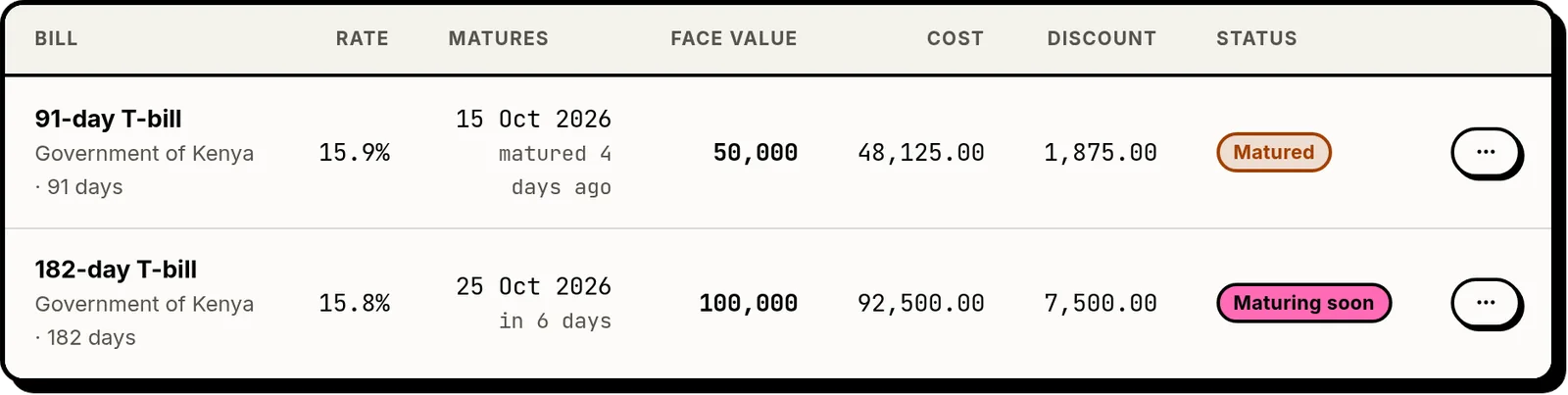
- Add the bill as a security under its government issuer, with its tenor, discount rate, issue date, and maturity date.
- Record the purchase at the price you paid.
- At maturity, record the redemption at face value and log the discount as discount income.
Discount income is always treated as withdrawn rather than reinvested in Clarifolio — if you roll the proceeds into another bill, that's recorded as a new purchase. See tracking T-bills and bonds.
Frequently asked questions
Do Treasury bills pay interest?
No. T-bills are bought at a discount to their face value and pay the full face value at maturity. The difference is your return, often called discount income.
How do you calculate the return on a Treasury bill?
Subtract the purchase price from the face value to get the discount, then divide by the purchase price for the return over the holding period. Multiply by 365 and divide by the number of days to maturity for a simple annualised rate.
Why is my calculated T-bill return different from the quoted rate?
Quoted rates often use a specific convention, such as a discount rate based on face value or a 360-day year, so they can differ slightly from a simple annualised return based on the price you paid.