A Dividend Tracker for Long-Term Investors
Log every dividend when it lands, mark how much you reinvested, and see your income by holding and by year — on any exchange, in your currency.
Most dividend trackers are built around forecasts: projected yield, upcoming ex-dates, a calendar that refreshes every morning. Clarifolio is built around the record. When a dividend lands in your account, you log it. Over time that log becomes the most honest answer to the question every income investor eventually asks: what has this portfolio actually paid me?
What you record
Each dividend is a single entry against the holding that paid it:
- The date it was received — the day the money actually arrived, not the declaration or ex-date.
- Amount per share and total amount — so you can compare payouts across years even as your position size changes.
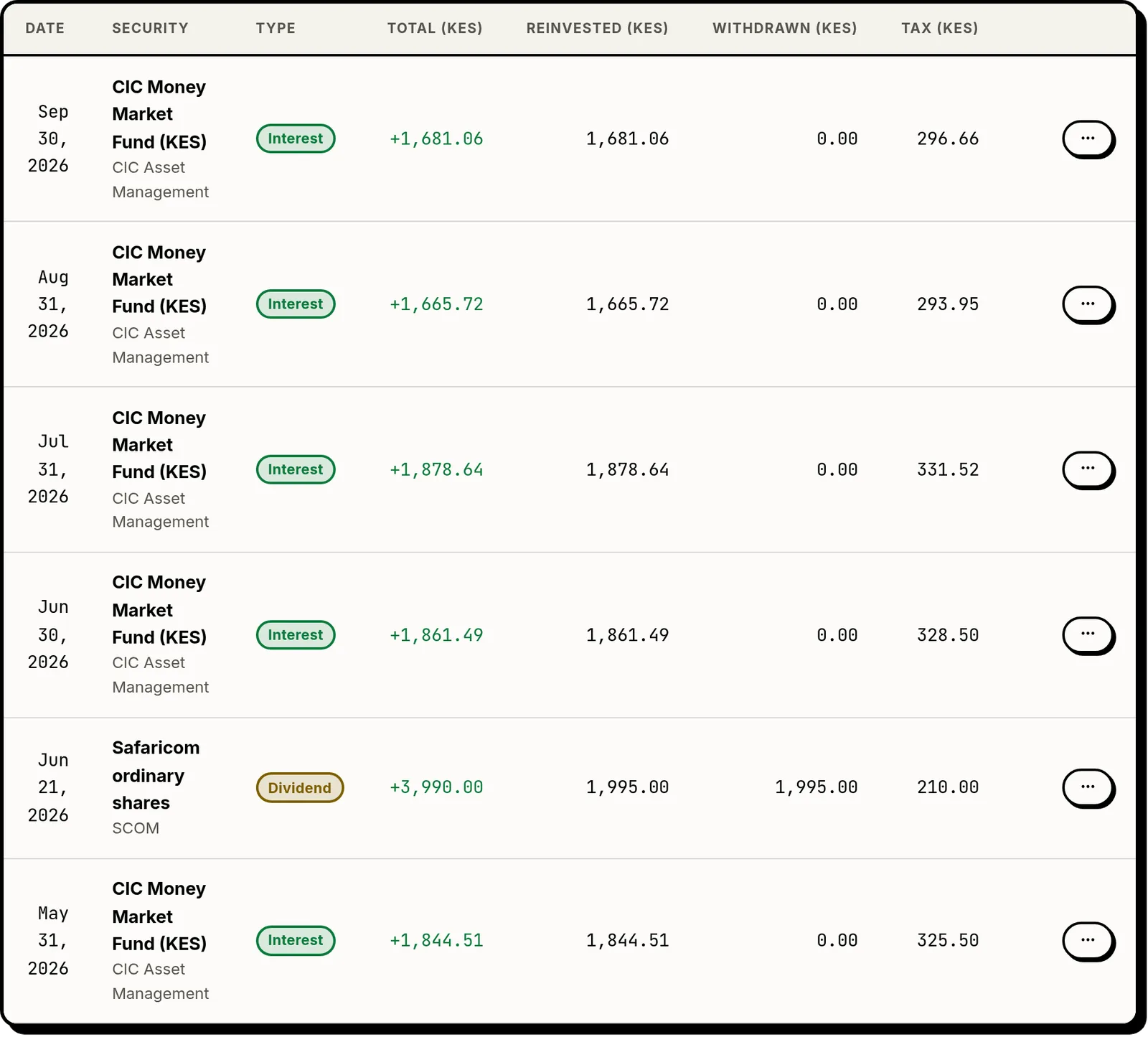
- How much you reinvested — the whole amount, part of it, or none. The rest is counted as withdrawn.
- Notes — anything worth remembering later: a special dividend, a scrip option you declined, withholding tax deducted at source.
Because each entry sits against a specific holding, you can see income per company as well as for the whole portfolio.
Reinvested or withdrawn — why it's worth recording
Two investors can receive exactly the same dividends and end up in very different places, depending on what they do with the cash. Marking each payment as reinvested or withdrawn at the moment it lands makes that decision visible. At the end of the year you can see how much of your income went back to work and how much you spent — without reconstructing it from bank statements. See reinvested vs. withdrawn dividends for how to think about the split.
Income from bonds and Treasury bills too
Dividends are only one kind of investment income. Clarifolio records three:
- Dividends from shares.
- Interest (coupon payments) from government and corporate bonds.
- Discount income from Treasury bills — the difference between what you paid and the face value you receive at maturity. See how Treasury bill discount income works.
All three roll up into one income total, so a portfolio that mixes shares and government securities can be read as a whole.
What Clarifolio doesn't do
It doesn't stream prices, send push notifications, or rank stocks by yield. It doesn't connect to your broker either — you enter what happened, which takes a minute per dividend, or import a file you've checked row by row, so nothing is ever imported wrong behind your back. If you want a feed to check every morning, there are good tools for that. Clarifolio is for the record you'll still want to read in ten years.
Getting started
The free plan covers up to 3 issuers (the companies or governments you hold), with unlimited dividends, trades, and interest on those holdings. Pro removes the issuer limit and adds money market funds, savings goals, every past monthly statement and the statement email, dashboard insights, Year in Review, a tax-year summary, and CSV export — see pricing.
Frequently asked questions
Can I track dividends from any stock exchange?
Yes. Clarifolio isn't tied to an exchange or a country — the exchange is simply a field on each issuer — and figures can be labeled in the currency you choose.
Does Clarifolio import dividends automatically?
Not automatically: there's no broker connection. You log each dividend when it arrives, which takes about a minute, or import a batch from an Excel or CSV file, such as a broker statement or your own sheet, after previewing every row. Either way the ledger records what actually reached your account, including any tax withheld.
Can I record a partially reinvested dividend?
Yes. Each dividend has a reinvested amount, which can be the full payment, part of it, or zero. Whatever isn't reinvested is counted as withdrawn.
Is there a free plan?
Yes. The free plan covers up to 3 issuers with unlimited dividend logging, and no card is required to register.